Visiting a Village Home: Manners That Actually Matter
Your guide opens a wooden door and says, come in, this is my cousin's house. Here is what to do with your shoes, where to sit, what to eat, and the one corner of the room you must never touch.
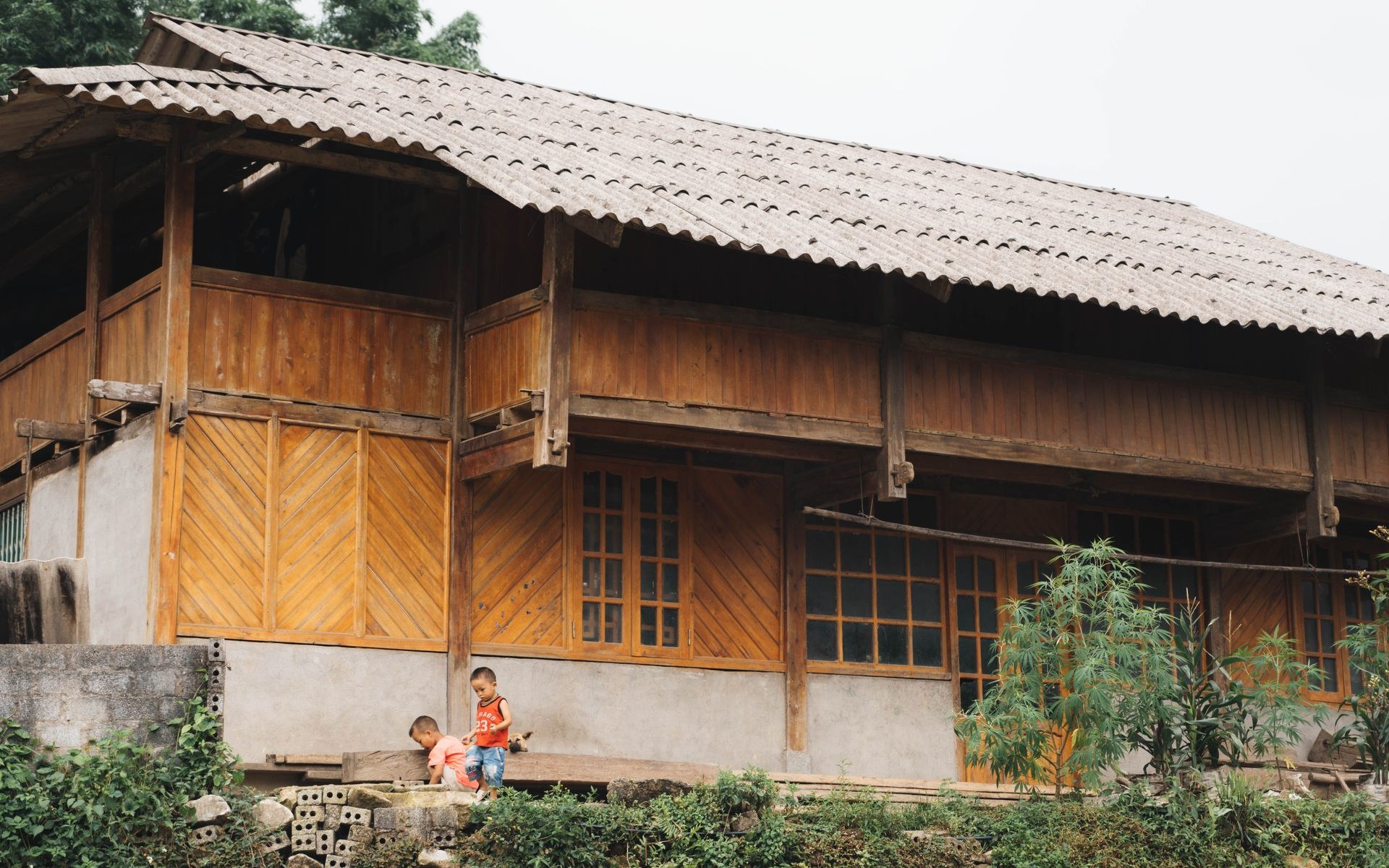
Cover photo: Quang Vuong via Pexels.
Your guide opens a low wooden door, ducks under the frame, and says, come in, this is my cousin's house. Inside it is dim after the bright trail, the floor is wood or packed earth, a fire burns low in the corner, and a whole family is looking at you with friendly curiosity. Nobody has told you the rules of this room. The rules are few and easy to follow, and getting them right is the difference between being a guest and being a tourist who walked through someone's living room.
The short answer
Take your shoes off at the door, sit where you are shown, accept the tea or food you are offered, and do not touch the altar or point your feet at it. Do those four things and the rest of the visit takes care of itself.
Shoes off, at the door
This is the first rule and the one everyone notices. Leave your shoes at the threshold, next to the family's shoes, before you step inside. The floor of a village house is where people sit, eat, and sleep, and muddy boots on it are an insult even if nobody says so. If the ground outside is wet, your socks will get damp on the walk from the door to your seat, and that is normal. Do not carry your shoes inside in your hand and look for a place to put them; the doorway is the place.
Sit where you are shown
Do not choose your own seat. Your host will point to a spot, usually a low stool or a place on the floor near the fire, and that spot is yours. Seats in a village home carry meaning: elders sit in the honoured places, and the seat nearest the altar is not yours to take. Sit cross-legged or with your legs folded to one side. Never stretch your legs out straight in front of you, and never point the soles of your feet at another person or at the altar.
The altar is not decoration
In most Hmong and Dao homes you will see a small altar on the wall, often in the main room, sometimes with incense, paper, or a small bowl in front of it. This is the most important object in the house. Do not touch it, do not lean on the wall beneath it, do not photograph it, and do not point at it. You do not need to understand what it means to respect it. The same respect applies to anything that looks like a ritual object. Leave it alone.
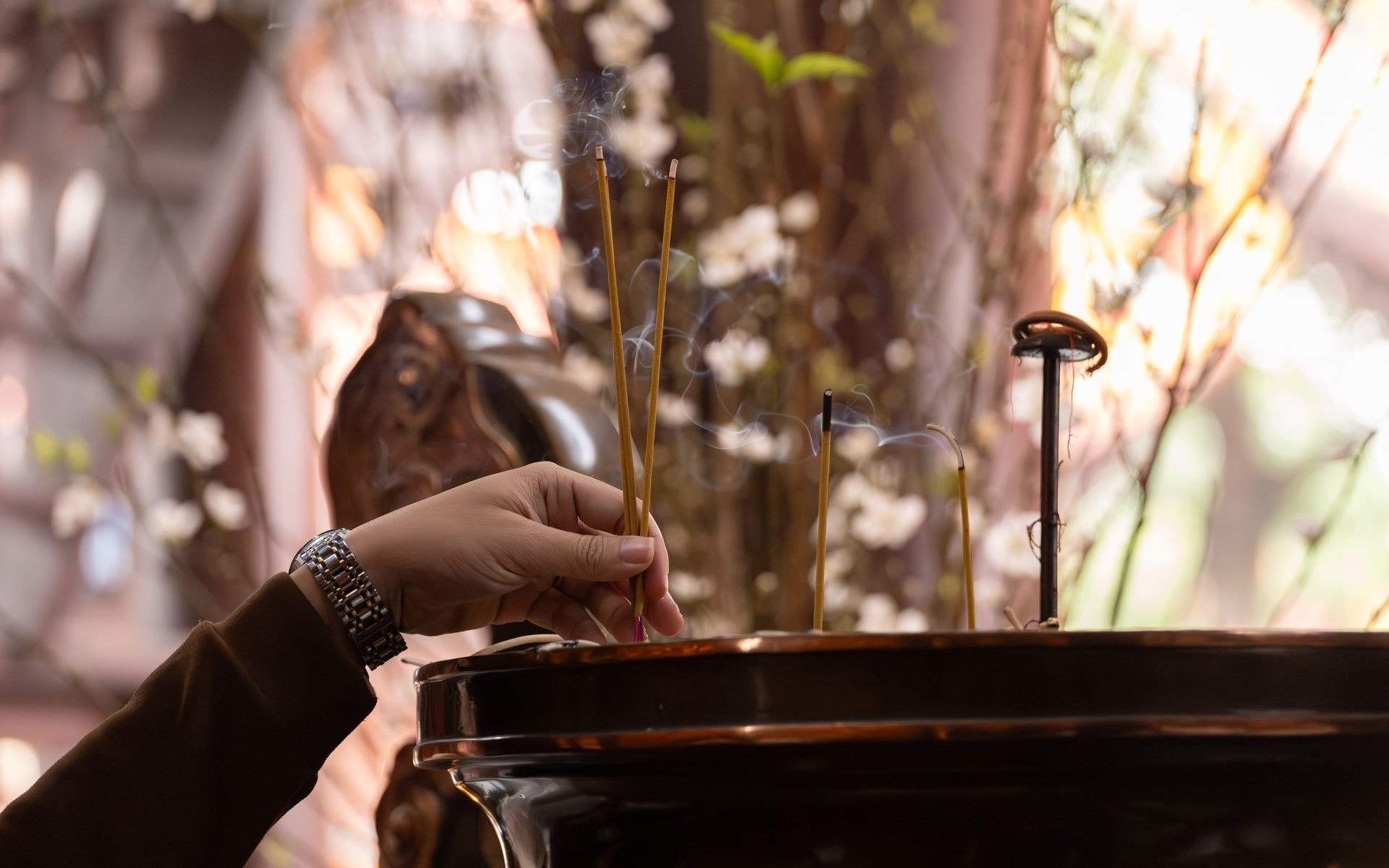
Source: Hồng Quang Official via Pexels. A hand lighting incense in Hanoi, an illustration of incense at a Vietnamese altar, never claimed as a village home altar.
Accept the tea, accept the food
You will be offered something, almost always tea, sometimes rice wine, often food. Accept it. Refusing a host's first offer is the fastest way to make a room go quiet, because it reads as a rejection of the household, not of the drink. You do not have to finish everything. Take the cup with both hands, take a sip, and set it down. If you are offered rice wine, a small sip is enough, and your guide can help you decline a second round. If you cannot eat something for health or allergy reasons, tell your guide before you enter the house, not at the table, so the guide can warn the family quietly.
When food is served, wait until the host or the eldest person starts eating. Do not help yourself to the serving dishes first. Eat what is put in your bowl, and do not leave a large amount uneaten if you can help it, but do not force yourself to finish a mountain of rice to be polite either. Do not put your chopsticks upright in a bowl of rice. That shape is used at funerals, and it is the one table mistake everyone in the room will notice.
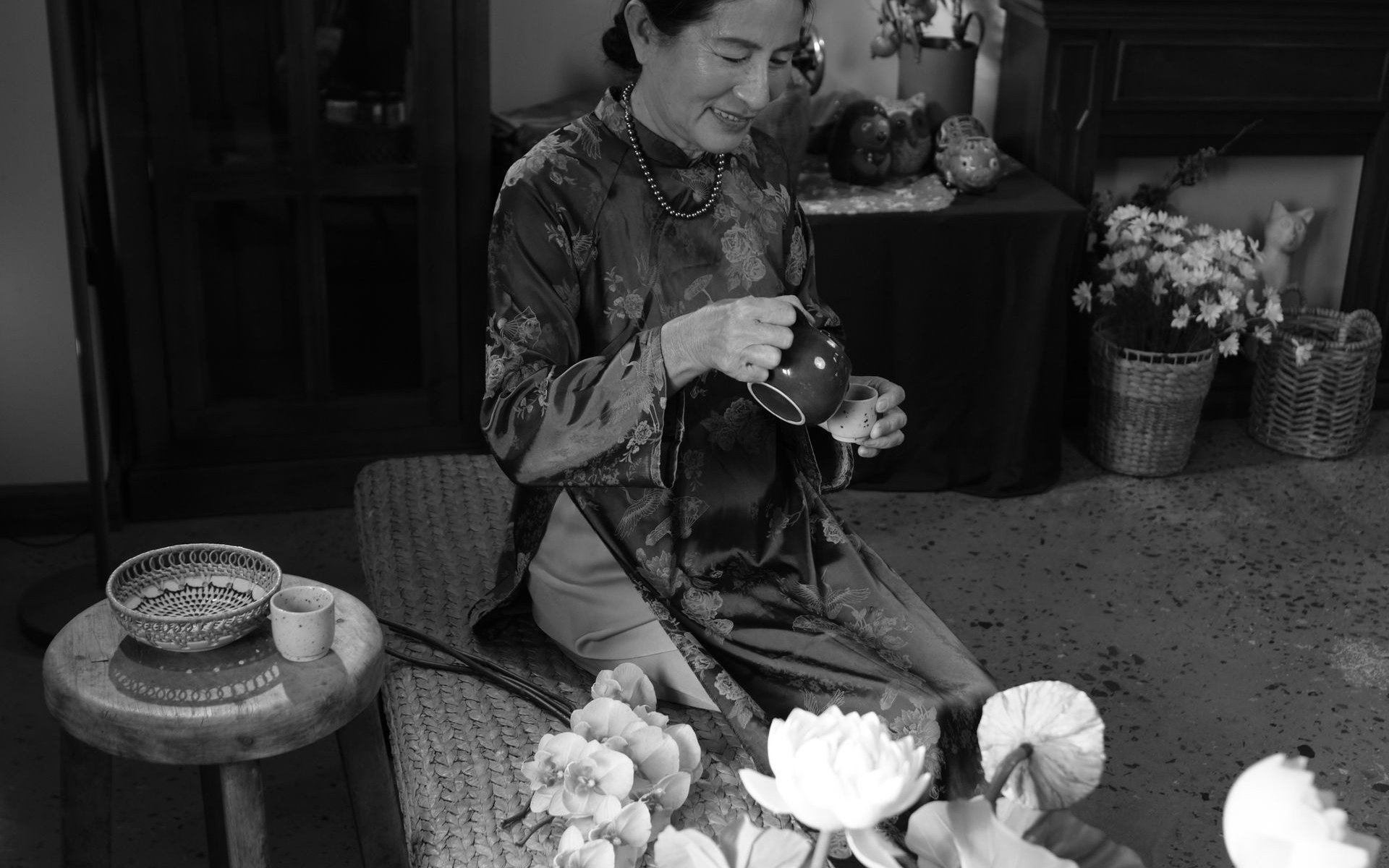
Source: Nguyen Truong Khang via Pexels. A tea ceremony in a Vietnamese home in Ben Tre, shown in black and white, never claimed as Ta Van.
Hands, heads, and passing things
Two small rules cover most of the rest. First, do not touch anyone's head, including a child's. The head is the highest and most respected part of the body, and ruffling a child's hair the way you might at home is not welcome here. Smile at children and keep your hands to yourself. Second, pass and receive things with both hands, or with your right hand supported by your left. A cup, a bowl, a gift: two hands say respect, one casual hand says you are in a hurry. It takes no extra effort and it is noticed.
Gifts: small, useful, and never cash to a child
If you want to bring something, bring something small and useful for the household, not cash and not sweets for the children. Fruit from Sapa town, a small bag of good tea, or a practical item for the kitchen are all welcome. Give it to the head of the household or to your guide to pass on, not directly to a child. Cash handed to a child teaches the next visitor's child to expect it. If a family gives you something, a piece of fruit or a small woven item, accept it with both hands and thank them. Refusing a gift is worse than accepting one you do not need.
If you get it wrong
You will get something wrong. You will forget and stretch your legs out, or you will reach for a cup with one hand. When it happens, do not freeze and do not make a long apology. A quick sorry, a smile, and a correction is enough. Village families are used to visitors who do not know the rules. Your guide is there to catch the big mistakes before they happen, so if you are unsure about anything, ask your guide quietly instead of guessing.
The next step
A visit to a village home is the part of a Sapa trek people remember longest, longer than any viewpoint, because it is the one moment when you are not looking at the valley but sitting inside it. Walk with a guide who knows the families, and you will be invited in rather than peering through a door. For a walk that ends with a night in a village homestay, see the 2-day Ta Van homestay trek, and read the Sapa trekking guide for the full picture of the routes, the seasons, and what to pack.
Walk it with us
Every route in these guides ends at Cloud Valley. Sleep where the trail ends, not back in town.
Sapa Trekking Guide · 1 Day Valley Trek · 2 Day Homestay Trek
More guides
Haggling in Sapa Market: How to Do It Without Offending
A vendor in Sapa market names a price for a woven bag, and you have no idea whether it is fair. Haggling is expected here, but there is a kind way to do it and a way that leaves everyone unhappy. Here is the kind way.

Gifts for Village Kids: What Helps and What Harms
A child runs up to you on a Sapa trail, smiling, hand out. Your hand goes to your pack. Before you give anything, here is what actually helps village kids, and what quietly harms them.

Language on the Trail: The Few Phrases That Open Doors
Your guide stops to chat with a farmer, everyone laughs, and you stand there smiling and understanding nothing. Ten Vietnamese phrases change the whole walk.